iGaming Times
    NewsiGT 25 IndexDirectoryRegulatory MapEventsLearningiGT 2025 LeadersiGT OracleAbout

    Stay Ahead of the Game

    Get the latest iGaming intelligence delivered to your inbox.

    iGaming Times

    The definitive source for iGaming industry intelligence, market data, and regulatory insights.

    Content

    • Latest News
    • Events
    • Learning Hub

    Resources

    • Directory
    • Regulatory Map
    • iGT 25 Index
    • iGT Leaders
    • iGT Oracle

    Company

    • About Us
    • Advertise
    • Contact
    • Careers

    Legal

    • Privacy Policy
    • Terms of Service
    • Cookie Policy

    © 2026 iGaming Times. All rights reserved.

    Market data provided for informational purposes only. Not financial advice.

    Home/News/Interviews

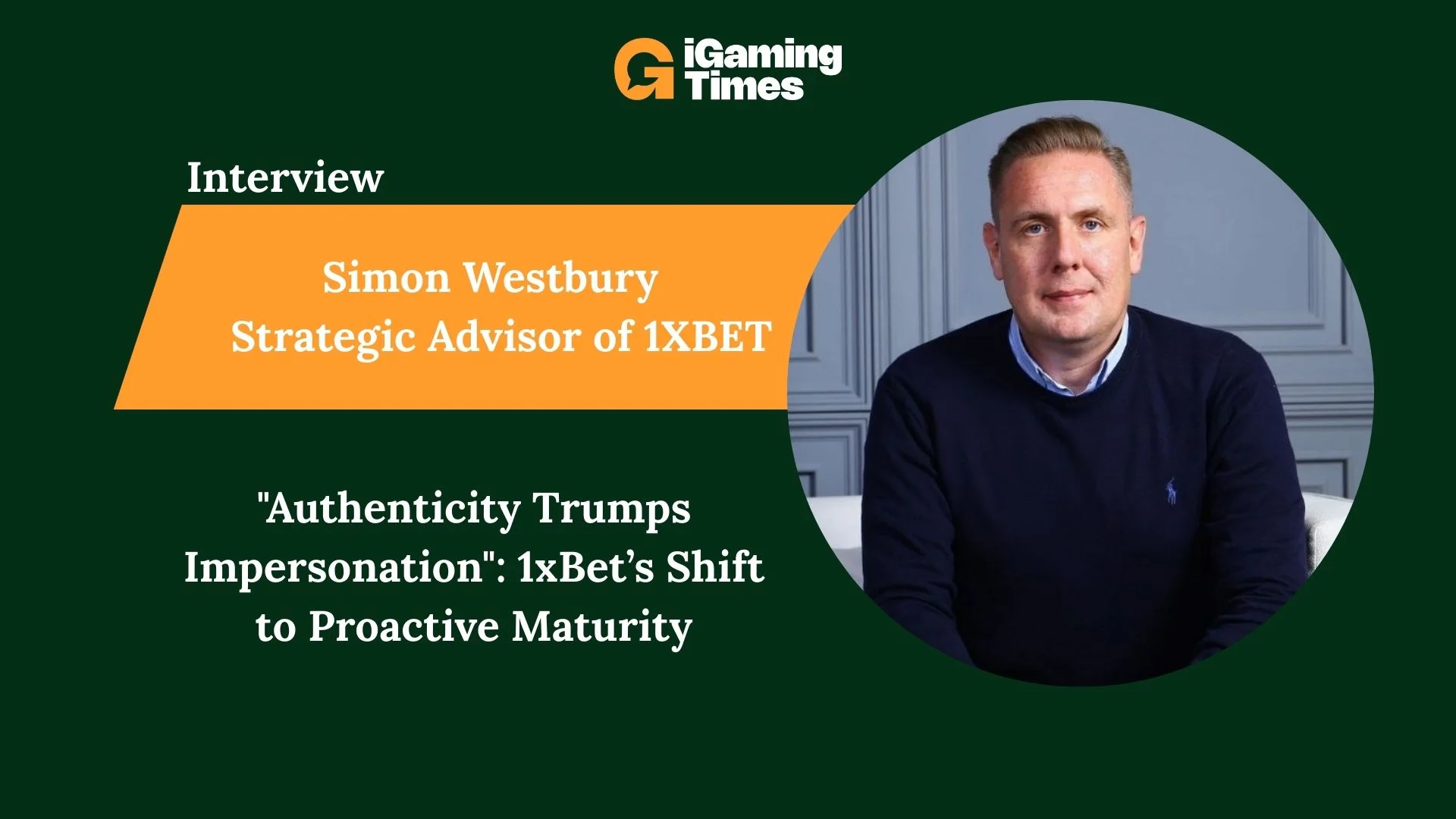
    "Authenticity Trumps Impersonation": Simon Westbury on 1xBet’s Shift to Proactive Maturity
    iGaming Times · Published January 7, 2026 · Updated April 15, 2026

    Crossing the floor from supplier to operator is a path well-trodden in the iGaming sector, but few make the leap with as much impact, or into as complex an organisation, as Simon Westbury.

    After years as the public face of major suppliers like Digitain and Sport Generate, Westbury took on the role of Strategic Advisor to 1xBet in July 2025. It was a move that raised eyebrows and signalled a distinct shift in strategy for the global giant. No longer content to sit in what Westbury terms a "defensive crouch", 1xBet is entering 2026 with a renewed focus on transparency, compliance, and cultural maturity.


    However, the transition has offered Westbury a unique vantage point on the industry’s shortcomings, particularly the "lazy" sales tactics of suppliers and the sector's struggle to justify its place in society.


    We sat down with Westbury to discuss the reality of Tier-1 operator needs, the "faddism" of AI, and why the industry must win back the argument with society.


    The Supplier Disconnect

    iGaming Times: From Supplier to Operator: You spent years as the face of the supplier side before crossing the floor to 1xBet in July 2025. Looking back at the last six months, what is the single biggest misconception suppliers have about what a Tier-1 operator actually needs?


    Simon Westbury: From the experience I have, and of course it is very new so it may be too early for me to truly substantiate this, but it is the belief that the operator simply needs your product. I do not know if it is a true representation of the level of sales professionals in the industry, but there does not seem to be any desire to understand the needs of the operator and what they may actually want. They often fail to identify the problem the salesperson is solving and the benefit to the ultimate end user of the product: the player.


    It seems to be a bit more "I know Simon, he can help me" and it is that simple. It is not. An operator's main time pressure is integration and product development. Without a business case, a need, or an obvious benefit, then it is not simple. Relationships are important, and I am on record as saying that one of my key learnings since joining is that the industry wants to engage with 1xBet. It is true they do, but I have to say I have found the majority of approaches to me rather lazy and not inspiring. If you are selling a product, be proud to sell it and sell it.


    From Defence to Partnership

    iGaming Times: You recently described 1xBet’s 2025 strategy as moving from a "defensive crouch" into "proactive maturity." How hard was it to shift the internal culture of such a massive organisation to stop reacting to the industry narrative and start shaping it?


    Simon Westbury: The internal shift is a demonstration of partnership. I saw a genuine commitment for internal change and a desire to engage with the industry before I joined. The negotiations between 1xBet and myself were protracted to some extent due to all the questions I was asking. The answers 1xBet not only gave but demonstrated through change relating to internal reorganisation and streamlining showed that, as an organisation, they committed to changing.


    I think the issue is more pertinent in that 1xBet has not normally reacted to industry narrative relating to them; instead, we have not engaged as a company. The desire to shape the industry narrative is really shown through the commitment we have undertaken regarding independent player protection research. This involves a series of global reports focusing on what lessons can be learnt from existing global regulations and how operators, regulators, and suppliers can all engage in a proactive discussion to ensure that players have a safe, exciting, and entertaining environment. We have published the first report focused on Western Europe, the next report on Africa will be published this month, and we are working on the third as we speak.


    Esports: Beyond the Niche

    iGaming Times: In 2025, 1xBet became the first Official Betting Partner of MIBR's VALORANT esports team. Was this the year esports betting finally graduated from a "niche engagement tool" to a genuine revenue pillar for the sportsbook?


    Simon Westbury: I do not think esports can be described as a niche product and I do not think they could have been for a long time. Esports is an intrinsic offering within your gaming portfolio; to simply label it a sportsbook product is a tad lazy. Yes, esports do sit on a sportsbook, but they are also a standalone product. To simply provide an esports player the same view, UI, and UX as a perceived sportsbook punter is lazy.


    I think we have seen the evolution over a number of years of operators paying more attention to this vertical and looking to engage with a new demographic of players that consume esports. To simply provide the same product in esports as you do for, say, football will only lead to a lack of engagement in your esports offering.


    In general terms, I think for a fully encompassing product you need to look past the generic. Of course, football is the main staple of most sportsbooks, but you also need regional specificity when you are a global operator. You also need a wide selection of sports, so outside of our activation and increased sponsorship in esports, we have also been engaged with FIBA and World Volleyball, for example.


    The Societal License to Operate

    iGaming Times: You spoke during Safer Gambling Week about how "confusion reigns over clarity" between governments and operators. Did 2025 bring us any closer to a unified dialogue, or is the gap between regulator capability and operator reality widening?


    Simon Westbury: I think we need to not just look at the gap between regulator and operator but also between iGaming as an industry and society. It is often forgotten that governments are the ones who set the laws that the regulators then turn into policy and regulation. For now, as an industry, I believe we have lost the argument in society about what we are, which is in a nutshell a form of entertainment.


    We are often perceived as "bad" and as an industry we do not shout enough about the good we do. Not just in CSR, but also in terms of measures like not having gambling ads in the UK during Covid and the voluntary ban on shirt sponsorships. I think it is important as an industry to not always push the envelope as much as possible or try and find loopholes, as these are simply picked up as the industry "up to their old tricks".


    I believe the discussion has moved forward, maybe not always in the most constructive manner, but I believe until we start addressing wider issues outside of regulation and engaging with governments and society, the road to a harmonious relationship between operators and regulators will also be fraught simply because regulators will be tightening regulation in line with government policies.


    The ‘Faddism’ Trap and AI Reality

    iGaming Times: You have criticised the industry’s addiction to "faddism." As we look at 2026, what is the one "shiny new toy" that you predict will crash and burn next year?


    Simon Westbury: I do not think we see any of the "fads" crash and burn; what I think we simply see is a lot more terms being used without fully understanding the potential of the tools being discussed. Tools such as AI are transformational, but this is the key point: when we use such terms in the industry we are often lazy and lacking in understanding what the tool's potential actually is.


    AI, I believe, will and maybe is already transforming the industry, but the key question for any organisation is: "What do we want from AI?" Many simply see AI as a tool for revenue generation but do not understand the wider possible benefits of the application of the tool. As with all tools, it can only be as good as its data. For example, a washing machine is a great tool, but it needs a human to load the washing machine, put the powder in, and set the wash cycle.


    I think these "fads" are here to stay. I simply implore that they are not used in a lazy manner. For example, Gamification: "Oh okay, let's stick a leaderboard on something, then we have gamified our product." Understand what you want from gamification or any of the tools mentioned and design the solution specifically to your offering, remembering always to have the player at the front and centre of everything you do. You may be selling to an operator, but always remember that operator is competing for retaining and attracting new players. So yes, the person in the operator is important as they are the buyer, but if the buyer's buyer-the end customer-does not like your product, then it is a short road to failure.


    A Parallel Strategy: Depth and Width

    iGaming Times: 1xBet acquired three new local licences in late 2025, bringing the total to over 35. For 2026, is the strategy to go deeper into these existing regulated markets (depth), or are you still in "land grab" mode for new territories (width)?


    Simon Westbury: I do not think it is fair to say 1xBet has ever been in "land grab" mode; our journey into regulated markets is historic and we have good pedigree here. As the gaming landscape has evolved, 1xBet has evolved and obtained licences where it makes business sense for us to enter a market.


    With the breadth of geos where we hold licences, we also have to, as you say, apply depth. That is because there is no "one size fits all" product that will appeal to players across different continents and countries within those continents. So to me, it will be a continuation of a parallel approach of entering into new regulated markets and ensuring our product has the depth in those markets to ensure that we become a market leader.


    Economic Headwinds and Consolidation

    iGaming Times: You jokingly referenced the tough UK budget (the "Rachel Reeves effect") when discussing your own 2026 planning. On a serious note, with tax pressures rising globally, do you foresee 2026 being a year of M&A and consolidation to protect margins?


    Simon Westbury: I think the Rachel Reeves effect really referenced the UK and it is clear from comments from people far wiser than me that it will be extremely difficult for new entrants into the UK market. Some existing operators will struggle and the market will be left with a few big players. The speculation is really on how much of the market will go offshore. I will say I do not think the tax revenue that the government expects from these tax changes will materialise to the level they predict.


    Naturally, there will always be some M&A there and I do believe that M&A will be probably more focused on the B2B side rather than the B2C side. Many players have multiple accounts across different operators and if one B2C site is suffering, the player will move to other sites. However, on the B2B side, M&A and the pooling of economies of scale or streamlining are more apparent. Sadly, I think for the job market this year things will become very tough and we will all have to be on the lookout to support our colleagues.


    The Quest for Hyper-Personalisation

    iGaming Times: Years ago, you talked about sports betting needing a "Netflix experience." Entering 2026, are we there yet?


    Simon Westbury: I do not think we are there yet, but maybe that is because my vision has not been realised. I accept that my vision is utopian and that every player has a tailored UI and UX to their preferences. I think we are moving along the road to increased personalisation, but we are not fully there yet.


    Again, this is a process and many tools and innovations adapting existing technologies to personalisation are happening. They may seem rudimentary or basic, but they are providing a personalised experience to some degree to players. I would say we are past the stage of a one-size-fits-all sportsbook unless you are a startup looking for a Turnkey Solution from some of the more basic B2B platform providers, but even most of them offer some variety. We are just not at the stage I envisioned in 2019, but that could be down to me, not the industry.


    Authenticity and the Buzzword Ban

    iGaming Times: You famously noted that "authenticity always beats wooden, unnatural, buzzword-driven interviews." If you could ban one buzzword from every C-Level keynote speech in 2026, what would it be?


    Simon Westbury: I think I could write an essay here. I think anything relating to "top-notch", "deep diving", "delving into", "forging", etc., can be lost. I always believe authenticity trumps impersonation and I believe many now in the industry focus on creating a personal profile rather than focusing on their jobs and delivering. They believe these nonsense buzzwords benefit their profile when it is actually the opposite.


    We all create our own paths and we are all individuals. All I ever wish for is for the authenticity to shine through and for individualism to prosper. Personally, I would also like to see AI only used for spelling and punctuation correction, rather than the drafting of speeches, posts, and interviews.

    Related articles in Interviews

    Interviews

    "Partners Judge by Swag": Sandra Bondare on Why the Cheap Hoodie is Costing You Deals

    Interviews

    "A Lot of Business is Done When There’s a Good Vibe": Eddie Bonello on the ROI of Event Mixology

    Interviews

    "We Don't Build a Game Factory": Anna Satori on Baking Soul Back into the Slot Machine

    Interviews

    "I Didn't Come This Far Just to Come This Far": Victoria Igbauboa on Redefining the 'Turnkey' Casino

    More Interviews news →

    Important Data
    FAKE_KEY_DO_NOT_USEHONEYPOT_TRAP
    1. Home
    2. News
    3. Interviews
    4. Authenticity trumps impersonation simon westbury on 1xbets shift to proactive maturity
    Back to News
    Interviews
    Europe
    Featured

    "Authenticity Trumps Impersonation": Simon Westbury on 1xBet’s Shift to Proactive Maturity

    "Authenticity Trumps Impersonation": Simon Westbury on 1xBet’s Shift to Proactive Maturity - Interviews iGaming news

    Crossing the floor from supplier to operator is a path well-trodden in the iGaming sector, but few make the leap with as much impact, or into as complex an organisation, as Simon Westbury.

    IT

    iGaming Times

    Wednesday, 7 January 202612 min read

    After years as the public face of major suppliers like Digitain and Sport Generate, Westbury took on the role of Strategic Advisor to 1xBet in July 2025. It was a move that raised eyebrows and signalled a distinct shift in strategy for the global giant. No longer content to sit in what Westbury terms a "defensive crouch", 1xBet is entering 2026 with a renewed focus on transparency, compliance, and cultural maturity.


    However, the transition has offered Westbury a unique vantage point on the industry’s shortcomings, particularly the "lazy" sales tactics of suppliers and the sector's struggle to justify its place in society.


    We sat down with Westbury to discuss the reality of Tier-1 operator needs, the "faddism" of AI, and why the industry must win back the argument with society.


    The Supplier Disconnect

    iGaming Times: From Supplier to Operator: You spent years as the face of the supplier side before crossing the floor to 1xBet in July 2025. Looking back at the last six months, what is the single biggest misconception suppliers have about what a Tier-1 operator actually needs?


    Simon Westbury: From the experience I have, and of course it is very new so it may be too early for me to truly substantiate this, but it is the belief that the operator simply needs your product. I do not know if it is a true representation of the level of sales professionals in the industry, but there does not seem to be any desire to understand the needs of the operator and what they may actually want. They often fail to identify the problem the salesperson is solving and the benefit to the ultimate end user of the product: the player.


    It seems to be a bit more "I know Simon, he can help me" and it is that simple. It is not. An operator's main time pressure is integration and product development. Without a business case, a need, or an obvious benefit, then it is not simple. Relationships are important, and I am on record as saying that one of my key learnings since joining is that the industry wants to engage with 1xBet. It is true they do, but I have to say I have found the majority of approaches to me rather lazy and not inspiring. If you are selling a product, be proud to sell it and sell it.


    From Defence to Partnership

    iGaming Times: You recently described 1xBet’s 2025 strategy as moving from a "defensive crouch" into "proactive maturity." How hard was it to shift the internal culture of such a massive organisation to stop reacting to the industry narrative and start shaping it?


    Simon Westbury: The internal shift is a demonstration of partnership. I saw a genuine commitment for internal change and a desire to engage with the industry before I joined. The negotiations between 1xBet and myself were protracted to some extent due to all the questions I was asking. The answers 1xBet not only gave but demonstrated through change relating to internal reorganisation and streamlining showed that, as an organisation, they committed to changing.


    I think the issue is more pertinent in that 1xBet has not normally reacted to industry narrative relating to them; instead, we have not engaged as a company. The desire to shape the industry narrative is really shown through the commitment we have undertaken regarding independent player protection research. This involves a series of global reports focusing on what lessons can be learnt from existing global regulations and how operators, regulators, and suppliers can all engage in a proactive discussion to ensure that players have a safe, exciting, and entertaining environment. We have published the first report focused on Western Europe, the next report on Africa will be published this month, and we are working on the third as we speak.


    Esports: Beyond the Niche

    iGaming Times: In 2025, 1xBet became the first Official Betting Partner of MIBR's VALORANT esports team. Was this the year esports betting finally graduated from a "niche engagement tool" to a genuine revenue pillar for the sportsbook?


    Simon Westbury: I do not think esports can be described as a niche product and I do not think they could have been for a long time. Esports is an intrinsic offering within your gaming portfolio; to simply label it a sportsbook product is a tad lazy. Yes, esports do sit on a sportsbook, but they are also a standalone product. To simply provide an esports player the same view, UI, and UX as a perceived sportsbook punter is lazy.


    I think we have seen the evolution over a number of years of operators paying more attention to this vertical and looking to engage with a new demographic of players that consume esports. To simply provide the same product in esports as you do for, say, football will only lead to a lack of engagement in your esports offering.


    In general terms, I think for a fully encompassing product you need to look past the generic. Of course, football is the main staple of most sportsbooks, but you also need regional specificity when you are a global operator. You also need a wide selection of sports, so outside of our activation and increased sponsorship in esports, we have also been engaged with FIBA and World Volleyball, for example.


    The Societal License to Operate

    iGaming Times: You spoke during Safer Gambling Week about how "confusion reigns over clarity" between governments and operators. Did 2025 bring us any closer to a unified dialogue, or is the gap between regulator capability and operator reality widening?


    Simon Westbury: I think we need to not just look at the gap between regulator and operator but also between iGaming as an industry and society. It is often forgotten that governments are the ones who set the laws that the regulators then turn into policy and regulation. For now, as an industry, I believe we have lost the argument in society about what we are, which is in a nutshell a form of entertainment.


    We are often perceived as "bad" and as an industry we do not shout enough about the good we do. Not just in CSR, but also in terms of measures like not having gambling ads in the UK during Covid and the voluntary ban on shirt sponsorships. I think it is important as an industry to not always push the envelope as much as possible or try and find loopholes, as these are simply picked up as the industry "up to their old tricks".


    I believe the discussion has moved forward, maybe not always in the most constructive manner, but I believe until we start addressing wider issues outside of regulation and engaging with governments and society, the road to a harmonious relationship between operators and regulators will also be fraught simply because regulators will be tightening regulation in line with government policies.


    The ‘Faddism’ Trap and AI Reality

    iGaming Times: You have criticised the industry’s addiction to "faddism." As we look at 2026, what is the one "shiny new toy" that you predict will crash and burn next year?


    Simon Westbury: I do not think we see any of the "fads" crash and burn; what I think we simply see is a lot more terms being used without fully understanding the potential of the tools being discussed. Tools such as AI are transformational, but this is the key point: when we use such terms in the industry we are often lazy and lacking in understanding what the tool's potential actually is.


    AI, I believe, will and maybe is already transforming the industry, but the key question for any organisation is: "What do we want from AI?" Many simply see AI as a tool for revenue generation but do not understand the wider possible benefits of the application of the tool. As with all tools, it can only be as good as its data. For example, a washing machine is a great tool, but it needs a human to load the washing machine, put the powder in, and set the wash cycle.


    I think these "fads" are here to stay. I simply implore that they are not used in a lazy manner. For example, Gamification: "Oh okay, let's stick a leaderboard on something, then we have gamified our product." Understand what you want from gamification or any of the tools mentioned and design the solution specifically to your offering, remembering always to have the player at the front and centre of everything you do. You may be selling to an operator, but always remember that operator is competing for retaining and attracting new players. So yes, the person in the operator is important as they are the buyer, but if the buyer's buyer-the end customer-does not like your product, then it is a short road to failure.


    A Parallel Strategy: Depth and Width

    iGaming Times: 1xBet acquired three new local licences in late 2025, bringing the total to over 35. For 2026, is the strategy to go deeper into these existing regulated markets (depth), or are you still in "land grab" mode for new territories (width)?


    Simon Westbury: I do not think it is fair to say 1xBet has ever been in "land grab" mode; our journey into regulated markets is historic and we have good pedigree here. As the gaming landscape has evolved, 1xBet has evolved and obtained licences where it makes business sense for us to enter a market.


    With the breadth of geos where we hold licences, we also have to, as you say, apply depth. That is because there is no "one size fits all" product that will appeal to players across different continents and countries within those continents. So to me, it will be a continuation of a parallel approach of entering into new regulated markets and ensuring our product has the depth in those markets to ensure that we become a market leader.


    Economic Headwinds and Consolidation

    iGaming Times: You jokingly referenced the tough UK budget (the "Rachel Reeves effect") when discussing your own 2026 planning. On a serious note, with tax pressures rising globally, do you foresee 2026 being a year of M&A and consolidation to protect margins?


    Simon Westbury: I think the Rachel Reeves effect really referenced the UK and it is clear from comments from people far wiser than me that it will be extremely difficult for new entrants into the UK market. Some existing operators will struggle and the market will be left with a few big players. The speculation is really on how much of the market will go offshore. I will say I do not think the tax revenue that the government expects from these tax changes will materialise to the level they predict.


    Naturally, there will always be some M&A there and I do believe that M&A will be probably more focused on the B2B side rather than the B2C side. Many players have multiple accounts across different operators and if one B2C site is suffering, the player will move to other sites. However, on the B2B side, M&A and the pooling of economies of scale or streamlining are more apparent. Sadly, I think for the job market this year things will become very tough and we will all have to be on the lookout to support our colleagues.


    The Quest for Hyper-Personalisation

    iGaming Times: Years ago, you talked about sports betting needing a "Netflix experience." Entering 2026, are we there yet?


    Simon Westbury: I do not think we are there yet, but maybe that is because my vision has not been realised. I accept that my vision is utopian and that every player has a tailored UI and UX to their preferences. I think we are moving along the road to increased personalisation, but we are not fully there yet.


    Again, this is a process and many tools and innovations adapting existing technologies to personalisation are happening. They may seem rudimentary or basic, but they are providing a personalised experience to some degree to players. I would say we are past the stage of a one-size-fits-all sportsbook unless you are a startup looking for a Turnkey Solution from some of the more basic B2B platform providers, but even most of them offer some variety. We are just not at the stage I envisioned in 2019, but that could be down to me, not the industry.


    Authenticity and the Buzzword Ban

    iGaming Times: You famously noted that "authenticity always beats wooden, unnatural, buzzword-driven interviews." If you could ban one buzzword from every C-Level keynote speech in 2026, what would it be?


    Simon Westbury: I think I could write an essay here. I think anything relating to "top-notch", "deep diving", "delving into", "forging", etc., can be lost. I always believe authenticity trumps impersonation and I believe many now in the industry focus on creating a personal profile rather than focusing on their jobs and delivering. They believe these nonsense buzzwords benefit their profile when it is actually the opposite.


    We all create our own paths and we are all individuals. All I ever wish for is for the authenticity to shine through and for individualism to prosper. Personally, I would also like to see AI only used for spelling and punctuation correction, rather than the drafting of speeches, posts, and interviews.

    Enjoyed this article? Share it:

    Comments

    Sign in to view and join the discussion

    Stay Informed

    Get the latest iGaming news delivered to your inbox.