
The Empathy Engine: Chaim Heber on How Chatform AI is Revolutionising iGaming Customer Support
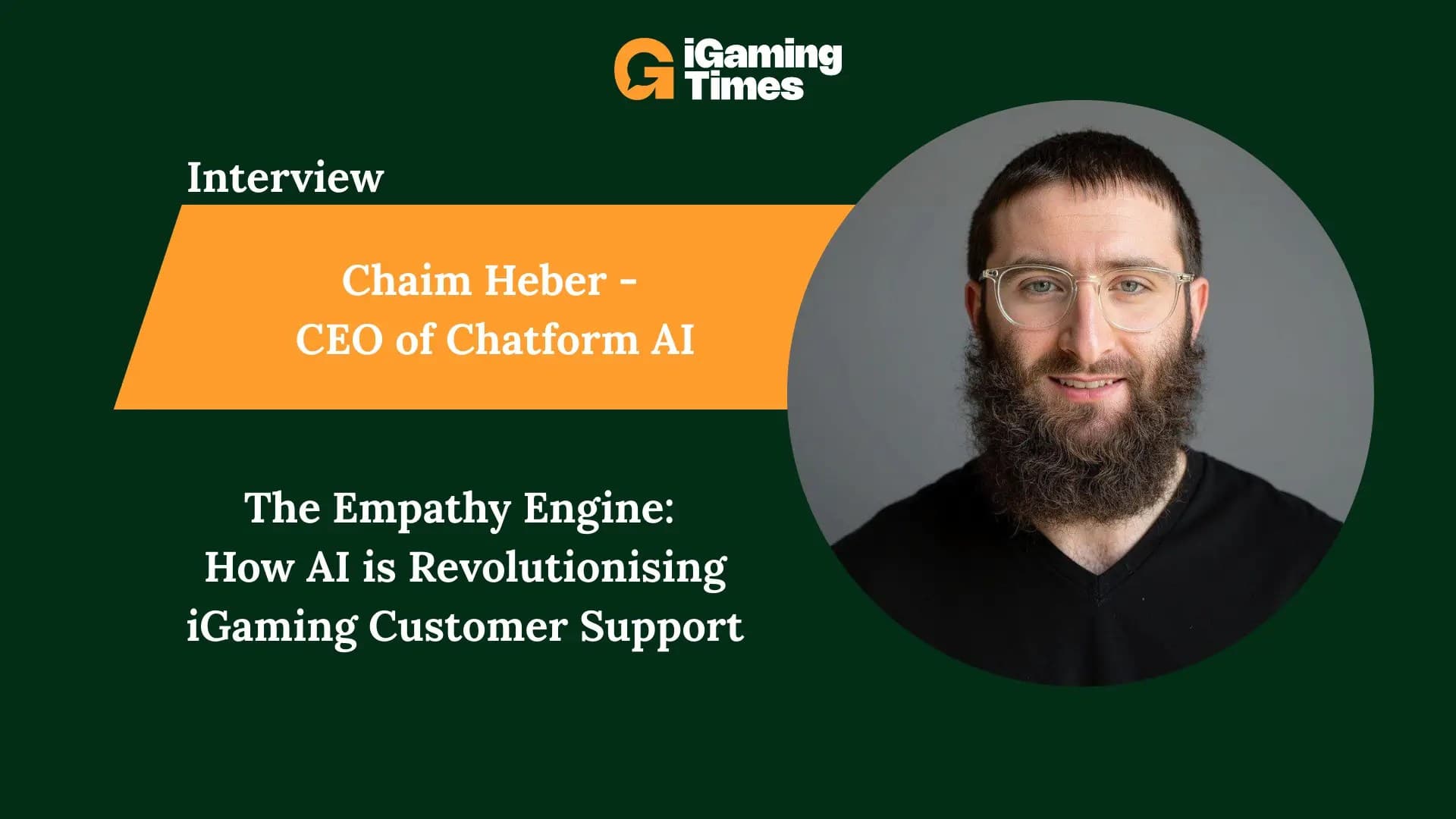
In an industry where customer experience can make or break a brand, players are no longer satisfied with slow, impersonal support. Recognizing this critical
iGaming Times
In an industry where customer experience can make or break a brand, players are no longer satisfied with slow, impersonal support. Recognizing this critical gap, Chatform AI has emerged as a trailblazer, pioneering a new era of AI-driven customer support that prioritises human-like empathy and genuine resolution. By moving beyond “stale chatbots,” the company aims to turn a traditional cost center into a powerful growth driver for iGaming operators.
To delve into this transformative vision, iGaming Times sat down with Chaim Heber, Co-founder and CEO of Chatform AI, to discuss the philosophy behind his company and its strategic approach to a customer-first future.
Innovation and Vision
iGaming Times: Chaim, Chatform AI positions itself as a revolutionary, empathetic AI Agent for iGaming. What was the core inspiration behind building Chatform AI specifically for this market, and what unique challenges did you identify in iGaming customer support that existing solutions weren’t addressing?
Chaim Heber: The inspiration for Chatform AI came from a simple observation: customer support was often neglected because it was considered “too difficult” to make truly delightful. As a result, players could feel that neglect viscerally. Typically, operators would either put a chatbot in place to deflect chats, which essentially built a wall between the brand and its players, or they would endlessly scale their internal support teams, risking a loss of quality or creating unsustainable costs. Personally, I absolutely hate talking to customer support chatbots. I’m that guy who starts typing “agent, agent, agent” immediately. I felt there had to be a way to get the best of both worlds, automation and efficiency, without sacrificing quality or ballooning support teams. In fact, the opposite should be true: we can actually improve the support experience with AI agents uniquely trained to be empathetic. So, we set out to build AI agents that would become superstar team members, not just bots. It’s like an in-house lineup of A-listers, equipped with all the right soft skills, without the actual headcount. These agents don’t just respond like many other solutions; they resolve real player issues with reasoning and empathy that is both capable and genuinely human-feeling.
Technological Edge
iGaming Times: You highlight “human reasoning and empathy” as key differentiators. Could you delve into the technological architecture or AI methodologies that allow Chatform AI to achieve this level of nuanced interaction, going beyond the typical “stale chatbot” experience?
Chaim Heber: It’s a good question, and I’m glad you asked. Some people have the misconception that building this empathic experience is easy, just copying a prompt into ChatGPT or making a conversational flow. The truth is, truly building an empathy-first AI agent is incredibly difficult; it’s not just about responding quickly with an FAQ answer or triggering an automated action. This involves entirely different reasoning, and empathy means the agent must deeply understand the player enough to know not just what to say, but how to say it. You have to delicately toe the line between company procedures and player experience. That nuance requires a vertical and domain-specific focus that I believe only Chatform has. Every message that comes in goes through our proprietary data reasoning pipeline to understand the exact outcome, taking into consideration many factors: for example, which player we are talking to, their sentiment, their recent activity and style, whether this situation requires input from the risk or fraud team, and so on. This ultimately generates a perfect and unique message for this player.
Impact on Customer Experience (CX)
iGaming Times: Chatform AI aims to “deliver mind-blowing customer experiences.” Can you provide specific examples or use cases where Chatform AI has significantly improved player satisfaction (CSAT) and overall player experience for operators? What metrics best demonstrate this improvement?
Chaim Heber: I think it’s important to remember that more often than not, when players reach out to support, they are already irritated. A delayed deposit blocking them from continuing to play is a typical example. In such cases, if an operator employs a chatbot, even if it can technically look up the deposit status, it doesn’t give the player a feeling of “I was helped” or “someone cares.” It’s cold, stale, and impersonal. What we see is that even in such cases, players who engage with our AI Agent are often calmed down and assured in a way that feels genuine that their deposit is being handled or that a ticket is created for the payments team to review. This all leads to what we’ve seen: operators who reach 4.8/5 CSAT while having over 70% automation. Automation should not result in a loss of quality; that’s yesterday’s automation. To ensure this, we track things like player sentiment, compliments given by players, frustration signals, and why the player left the chat. The typical metrics, like time to resolution, often miss the important signals of what is going on in the conversation and why.
Integration and ROI
iGaming Times: How does Chatform AI typically integrate with existing CRM systems and operational workflows, and what kind of quantifiable operational efficiencies or ROI can iGaming businesses expect to see, particularly regarding ticket resolution rates and staffing optimisation?
Chaim Heber: This speaks to vertical specificity again. Knowing what to expect in an integration or having the ability for operators to integrate multiple systems is key to making these initiatives succeed. A typical example is a multi-brand operator who might have some brands on one platform and others on a different one. Our ability to hold our customers’ hands through the integration process is a core element. We also truly believe in the value of industry-specific integration partners, like the familiar CRMs that might help with bonus queries or mini-game issues. Importantly, and to answer the question directly, the AI Agent is only as good as the data it has; the same goes for humans, obviously. Imagine hiring a support agent but not allowing them to look up a player’s recent deposits. We tailor our onboarding process and align with our clients to meet their requirements, understand what can be integrated and what they prefer not to, and then outline the exact mutual action plan together. So, it really is in each operator’s hands. But to give you an example, we’ve been able to achieve an automated resolution rate above 80%. If you take a minute to think about that, it’s truly remarkable not only for efficiency gains and faster resolution times, but because agents are by default upskilled and empowered to work on actual decisions effectively. Take, for example, a typical frontline agent who may be juggling five chats at the same time while communicating internally across teams and looking up the back office. That all takes time. But if agents don’t have to worry about these areas and can focus on making decisions in nuanced cases, it’s hard to overstate the impact.
Building Player Rapport and LTV
iGaming Times: The concept of building rapport with players is crucial, especially in iGaming. How does Chatform AI achieve this “personalisation and memory” to genuinely connect with players and, in turn, drive up Lifetime Value (LTV)? Are there specific features that facilitate this?
Chaim Heber: Yes, when players come to chat, they expect a very high level of personalisation, like remembering previous interactions and their outcomes, or maybe the type of bonus they prefer. Our personalisation engine remembers player preferences, recent activity, language choice, and even conversation history across channels. This allows Chatform AI to greet returning players with a personalised reference to a previous interaction, or perhaps greet a first-time depositor differently. It’s pretty simple, actually: if you know your players well and they feel personally known, they stick around.
Responsible Gaming (RG) and Compliance
iGaming Times: Regulatory compliance and Responsible Gaming are paramount in the iGaming industry. How do Chatform AI’s “advanced RG AI guardrails” and “AI localization policies” function to ensure operators remain compliant while scaling internationally?
Chaim Heber: Chatform AI embeds advanced RG guardrails that monitor and detect player sentiment, blacklist words, and follow procedures according to local regulations. You might handle a closed account differently in one market versus another. If the AI detects these instances, it can adapt the conversation to encourage breaks, initiate a cool-off period, provide resources, or alert the RG team and escalate to human support in line with local regulations. Our AI localization policies ensure that both language and compliance rules are configured to the player’s jurisdiction, making it easier for operators to scale internationally without risking regulatory breaches.
The Future of AI in iGaming Support
iGaming Times: Looking ahead, where do you see the evolution of AI-driven customer support in the iGaming sector over the next 3-5 years? What new capabilities or integrations can we expect from Chatform AI to meet these future demands?
Chaim Heber: I think that the iGaming market is super competitive. It’s too easy for players to move from one brand to the next, and given any reason, they easily churn. Over the next few years, I believe more operators will realise that they are sitting on a gold mine, and that customer support is not just an annoying, cost-driving function of the business, but a chance to essentially have a personal concierge, slash account manager, slash salesperson for every single player. The industry is going to move more and more towards utilising these touchpoints to build loyalty with players. Our roadmap is insane and exciting. I can’t share everything here, but every day I’m more excited for the future. Sometimes it can feel foreign thinking about what the future will bring, but I’m an optimist and believe we will be better off. All our integrations, product decisions, features, and roadmap follow the same vision: how can we make players feel connected to the brand in the same way you feel when you go to that local brewery and the bartender knows exactly what you want to drink?
Challenges and Growth
iGaming Times: As a co-founder and CEO, what has been the most significant challenge in bringing Chatform AI to market and achieving its current success? What are your key priorities for Chatform AI’s growth and development in the coming year?
Chaim Heber: The biggest challenge was overcoming industry scepticism. Many operators had been burned by “AI chatbots” that overpromised and underdelivered, or they were being pushed around by their legacy providers. We had to prove we are playing in a different league. In the coming year, our priority is to expand to different markets, and deepen integrations with leading gaming platforms to establish Chatform AI as the default support layer for global operators.
Advice for Operators
iGaming Times: For iGaming operators considering the adoption of AI Agents, what key advice would you offer to ensure a successful implementation and maximise the benefits of this technology?
Chaim Heber: Think big but start small; the capabilities are advancing day by day, and you don’t need to go from 0 to 100 overnight. Start with a clear plan for AI adoption: define the KPIs you want to impact, involve your teams early, and train the AI on your brand’s tone and policies. At the same time, you want to work with a provider that sees the future, innovates, trailblazes, and pushes the boundaries of what is possible. I think it’s important to find a provider that understands your domain and knows what is possible and how to get the best results.
Vision for the Industry
iGaming Times: If you could wave a magic wand and change one thing about the current state of customer support in the iGaming industry, what would it be and why?
Chaim Heber: Like I mentioned before, I would want the future to be here today. It is the most exciting version of the future that we’ve ever been on the precipice of. But to get there, operators will need to shift their mindset from “cost center” to “growth driver” when it comes to customer support. Support should not only solve problems; it should build relationships, retain players, and drive brand advocacy. With the right AI tools, this transformation is not just possible, it’s inevitable.
Enjoyed this article? Share it: